

Capacitor Bank Industry Outlook, Trends, Share, and Forecast Through 2033
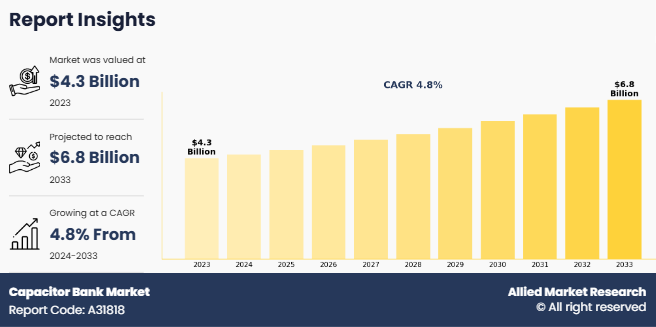
Capacitor bank market is projected to reach $6.8 billion by 2033, driven by renewable energy and grid efficiency needs.
Growing power factor correction demand and renewable energy integration boost capacitor bank market growth.”
WILMINGTON, DE, UNITED STATES, June 1, 2026 /EINPresswire.com/ -- — Allied Market Research
According to a new report published by Allied Market Research, the capacitor bank market size was valued at $4.3 billion in 2023 and is projected to reach $6.8 billion by 2033, registering a CAGR of 4.8% from 2024 to 2033. The increasing integration of renewable energy sources, rising demand for power factor correction, modernization of power infrastructure, and growing investments in industrial electrification are key factors driving the growth of the capacitor bank market globally.
Download PDF Brochure: https://www.alliedmarketresearch.com/request-sample/32268
Introduction
A capacitor bank is an assembly of multiple capacitors connected in series or parallel to store and release electrical energy efficiently. These systems are widely used across industrial, commercial, and utility applications to improve power factor, reduce energy losses, and maintain voltage stability within electrical networks. As modern power systems become increasingly complex, capacitor banks have emerged as critical components for improving the reliability and efficiency of electricity transmission and distribution systems.
The growing emphasis on energy efficiency and sustainable power management has significantly increased the adoption of capacitor banks worldwide. Utilities and industrial facilities rely on these systems to minimize reactive power losses, improve equipment performance, and lower operational costs. In addition, the rapid expansion of renewable energy projects has created new opportunities for capacitor bank deployment, as these systems help maintain voltage quality and grid stability despite fluctuations in power generation.
As governments and private organizations continue investing in energy infrastructure upgrades, the capacitor bank market is expected to witness steady growth throughout the forecast period.
Importance of Capacitor Banks in Modern Power Systems
Capacitor banks play a crucial role in maintaining the efficiency of electrical networks. One of their primary functions is power factor correction, which helps improve the ratio between useful power and total power supplied. A low power factor results in higher current flow, increased transmission losses, and elevated electricity costs. By compensating for reactive power, capacitor banks enhance system efficiency and reduce unnecessary energy consumption.
In modern industrial facilities, electrical loads such as motors, transformers, welding equipment, and HVAC systems often create reactive power demand. Without adequate compensation, these loads can reduce overall system performance and increase energy expenses. Capacitor banks help offset these inefficiencies, enabling businesses to optimize energy utilization while improving operational reliability.
Power utilities also depend on capacitor banks to maintain voltage levels across transmission and distribution networks. Stable voltage is essential for ensuring uninterrupted power supply to residential, commercial, and industrial consumers. As electricity demand continues to rise globally, capacitor banks are becoming increasingly important in supporting efficient grid operations.
Renewable Energy Integration Driving Market Growth
The transition toward renewable energy has become one of the most significant trends influencing the capacitor bank market. Governments worldwide are accelerating investments in solar and wind energy projects to reduce carbon emissions and achieve sustainability targets. However, renewable energy generation often introduces voltage fluctuations and reactive power challenges due to its intermittent nature.
Capacitor banks provide an effective solution for managing these fluctuations by improving voltage regulation and reactive power compensation. During periods of high solar irradiance or strong wind activity, power generation can increase rapidly, placing stress on the electrical grid. Capacitor banks help stabilize the network and ensure reliable power delivery.
The growing deployment of utility-scale solar farms and wind energy installations has significantly increased the demand for capacitor bank systems. Renewable energy developers are incorporating these solutions into projects to improve power quality and maintain grid compliance requirements.
Investments in renewable energy infrastructure across countries such as India, Australia, China, Germany, and the United States are expected to create substantial opportunities for the capacitor bank market during the coming decade. As clean energy adoption continues to accelerate, capacitor banks will remain essential for ensuring efficient integration of renewable power into electrical networks.
Rising Need for Power Factor Correction
Power factor correction remains one of the most important applications supporting the growth of the capacitor bank market. Industries with large electrical loads often face penalties from utilities when operating at low power factors. To avoid these costs and improve system efficiency, organizations increasingly invest in capacitor bank installations.
Power factor correction reduces current demand on electrical networks, leading to lower transmission losses and improved energy efficiency. This translates into reduced electricity bills, better utilization of electrical equipment, and enhanced system reliability. Industries such as manufacturing, mining, oil and gas, chemicals, and data centers heavily rely on capacitor banks for these benefits.
As energy costs continue to rise globally, businesses are prioritizing technologies that improve operational efficiency and reduce power wastage. This trend is expected to drive sustained demand for capacitor bank systems across multiple industrial sectors.
Alternative Technologies Creating Market Challenges
Despite strong growth prospects, the capacitor bank market faces competition from advanced power electronics technologies. Solutions such as Static VAR Compensators (SVCs) and Static Synchronous Compensators (STATCOMs) are increasingly being adopted for reactive power management and voltage regulation.
These technologies offer several advantages, including faster response times, real-time voltage control, and greater adaptability to fluctuating power conditions. Their integration with digital control systems and smart grid technologies makes them particularly attractive for modern power networks.
As utilities seek more dynamic solutions for energy management, SVCs and STATCOMs are gaining popularity in large-scale applications. This trend presents a challenge for traditional capacitor bank systems, encouraging manufacturers to focus on innovation, automation, and enhanced performance capabilities.
However, capacitor banks continue to offer significant advantages in terms of cost-effectiveness, simplicity, and reliability. For many industrial and commercial applications, they remain the preferred choice for power factor correction and voltage support.
Buy This Report (398 Pages PDF with Insights, Charts, Tables, and Figures): https://www.alliedmarketresearch.com/capacitor-bank-market/purchase-options
Market Segmentation Analysis
Voltage Segment Analysis
Based on voltage, the capacitor bank market is segmented into less than 1 kV, 1 kV to 10 kV, 10 kV to 69 kV, and above 69 kV categories. Among these, the 10 kV to 69 kV segment is expected to witness the fastest growth during the forecast period, registering a CAGR of 5.1%.
Distribution networks operating within this voltage range serve a wide variety of industrial and commercial consumers. Maintaining voltage stability in such systems is essential for ensuring uninterrupted operations and preventing equipment failures. Capacitor banks help reduce voltage drops and improve overall network performance, making them indispensable in medium-voltage applications.
As industrial automation and digital infrastructure continue to expand, demand for reliable medium-voltage power systems is expected to support the growth of this segment.
Type Segment Analysis
On the basis of type, the market is divided into externally fused, internally fused, and fuseless capacitor banks. The internally fused segment is projected to grow at the fastest rate during the forecast period.
Internally fused capacitor banks provide enhanced safety and operational reliability. When individual capacitor elements fail, internal fuses isolate the fault automatically without affecting the performance of the entire system. This feature minimizes downtime and reduces maintenance requirements.
Industries increasingly prefer internally fused capacitor banks because of their ability to maintain continuous operation while improving system protection. As organizations seek more efficient and reliable power management solutions, adoption of internally fused systems is expected to rise steadily.
Installation Segment Analysis
By installation type, the market includes pole-mounted systems, open-air substations, metal-enclosed substations, and others. Among these, metal-enclosed substations are emerging as the fastest-growing segment.
Metal-enclosed substations offer a compact and secure solution for housing transformers, switchgear, and capacitor banks within a protective enclosure. Their space-saving design and enhanced safety features make them suitable for industrial facilities, commercial complexes, and urban power distribution networks.
The growing focus on infrastructure modernization and smart substations is expected to accelerate demand for capacitor banks installed within metal-enclosed systems.
Application Segment Analysis
Capacitor banks are widely used across applications including power factor correction, industrial operations, harmonic filtering, and other specialized functions. Industrial applications account for a significant share of the global market due to the extensive use of electrical equipment requiring reactive power compensation.
Industrial facilities depend on capacitor banks to improve efficiency, reduce energy losses, and enhance equipment performance. The increasing adoption of automation technologies and high-power machinery is expected to further strengthen demand across industrial sectors.
Asia-Pacific Emerges as the Fastest-Growing Regional Market
Asia-Pacific has emerged as the fastest-growing region in the capacitor bank market. Rapid industrialization, urbanization, and infrastructure development are driving demand for reliable and efficient power systems throughout the region.
Countries such as China, India, Japan, South Korea, and Australia are making substantial investments in renewable energy projects, smart grids, and power distribution networks. These initiatives require advanced voltage regulation and reactive power management solutions, creating significant opportunities for capacitor bank manufacturers.
The region’s expanding manufacturing sector also contributes to market growth. Industries increasingly rely on capacitor banks to improve power quality and reduce operational costs. Furthermore, government policies promoting energy efficiency and grid modernization are expected to support long-term market expansion.
With Asia-Pacific accounting for more than one-third of global market revenue in 2023, the region is likely to maintain its leadership position throughout the forecast period.
Technological Innovations Shaping the Industry
Technological advancements continue to transform the capacitor bank market. Manufacturers are focusing on developing intelligent capacitor bank systems equipped with digital monitoring, remote control, and predictive maintenance capabilities.
The integration of Internet of Things (IoT) technologies and advanced analytics enables operators to monitor system performance in real time and identify potential issues before they cause disruptions. These capabilities improve operational efficiency while reducing maintenance costs.
Recent product launches also highlight ongoing innovation within the industry. Companies are introducing compact capacitor bank designs, harmonic filtering solutions, and high-capacity energy storage systems to meet evolving customer requirements.
As smart grid adoption increases globally, intelligent capacitor bank systems are expected to play a larger role in modern electrical infrastructure.
Competitive Landscape
The capacitor bank market remains highly competitive, with leading companies investing in research, product innovation, and geographic expansion. Major participants include Toshiba Corporation, Siemens, Hitachi Ltd., ABB Ltd., Eaton, Vishay Intertechnology Inc., Circutor, Enerlux Power, Comar Condensatori, and EPCOS.
These companies continue to strengthen their market positions through technological innovation, strategic partnerships, acquisitions, and expansion into emerging markets. Their efforts are helping accelerate the adoption of advanced capacitor bank solutions worldwide.
Get a Customized Research Report: https://www.alliedmarketresearch.com/request-for-customization/A31818
Future Outlook
The future of the capacitor bank market remains promising as global energy systems become increasingly sophisticated and interconnected. Rising electricity demand, growing renewable energy integration, and increasing investments in grid modernization will continue to drive market expansion.
Industrial facilities are expected to remain major consumers of capacitor bank systems as organizations seek to improve energy efficiency and reduce operational expenses. At the same time, renewable energy developers will continue relying on capacitor banks to maintain voltage stability and support grid integration.
Advancements in digital monitoring, automation, and smart grid technologies are likely to enhance the performance and functionality of capacitor banks, making them even more valuable in modern power systems.
With strong demand from utilities, industries, and renewable energy projects, the capacitor bank market is expected to reach $6.8 billion by 2033, reinforcing its critical role in achieving efficient, reliable, and sustainable electricity networks worldwide.
Trending Reports in Energy and Power Industry:
Capacitor Bank Market
https://www.alliedmarketresearch.com/capacitor-bank-market-A31818
Ceramic Capacitor Market
https://www.alliedmarketresearch.com/ceramic-capacitor-market-A219122
Electric Capacitor Market
https://www.alliedmarketresearch.com/electric-capacitor-market-A12848
High Voltage Capacitor Market
https://www.alliedmarketresearch.com/high-voltage-capacitors-market
Electrical Grid Market
https://www.alliedmarketresearch.com/electrical-grid-market-A325514
Circuit Breakers Market
https://www.alliedmarketresearch.com/circuit-breakers-market
Medium Voltage Switchgear Market
https://www.alliedmarketresearch.com/medium-voltage-switchgear-market-A31300
Electrostatic Precipitator Market
https://www.alliedmarketresearch.com/electrostatic-precipitator-system-market
Busbar Market
https://www.alliedmarketresearch.com/busbar-market
Synchronous Condenser Market
https://www.alliedmarketresearch.com/synchronous-condenser-market-A10591
Electrical House (E-House) Market
https://www.alliedmarketresearch.com/e-house-market
Cast Resin Dry Type Transformer Market
https://www.alliedmarketresearch.com/cast-resin-dry-type-transformer-market-A15001
Aluminum Bare Wire Conductor Market
https://www.alliedmarketresearch.com/aluminum-bare-wire-conductor-market-A325757
Three Phase Sectionalizer Market
https://www.alliedmarketresearch.com/three-phase-sectionalizer-market-A159903
About Us
Allied Market Research (AMR) is a full-service market research and business-consulting wing of Allied Analytics LLP based in Portland, Oregon. Allied Market Research provides global enterprises as well as medium and small businesses with unmatched quality of "Market Research Reports" and "Business Intelligence Solutions." AMR has a targeted view to provide business insights and consulting to assist its clients to make strategic business decisions and achieve sustainable growth in their respective market domain.
Pawan Kumar, the CEO of Allied Market Research, is leading the organization toward providing high-quality data and insights. We are in professional corporate relations with various companies and this helps us in digging out market data that helps us generate accurate research data tables and confirms utmost accuracy in our market forecasting. Each and every data presented in the reports published by us is extracted through primary interviews with top officials from leading companies of domain concerned. Our secondary data procurement methodology includes deep online and offline research and discussion with knowledgeable professionals and analysts in the industry.
David Correa
Allied Market Research
+ + + + + + + + + + + + +1 800-792-5285
email us here
Visit us on social media:
LinkedIn
Facebook
YouTube
X
Legal Disclaimer:
EIN Presswire provides this news content "as is" without warranty of any kind. We do not accept any responsibility or liability for the accuracy, content, images, videos, licenses, completeness, legality, or reliability of the information contained in this article. If you have any complaints or copyright issues related to this article, kindly contact the author above.
